Organisational compliance management: when having policies is no longer enough

Organisational_compliance_management_when_having_policies_is_no_longer_enough

Organisational compliance management: when having policies is no longer enough

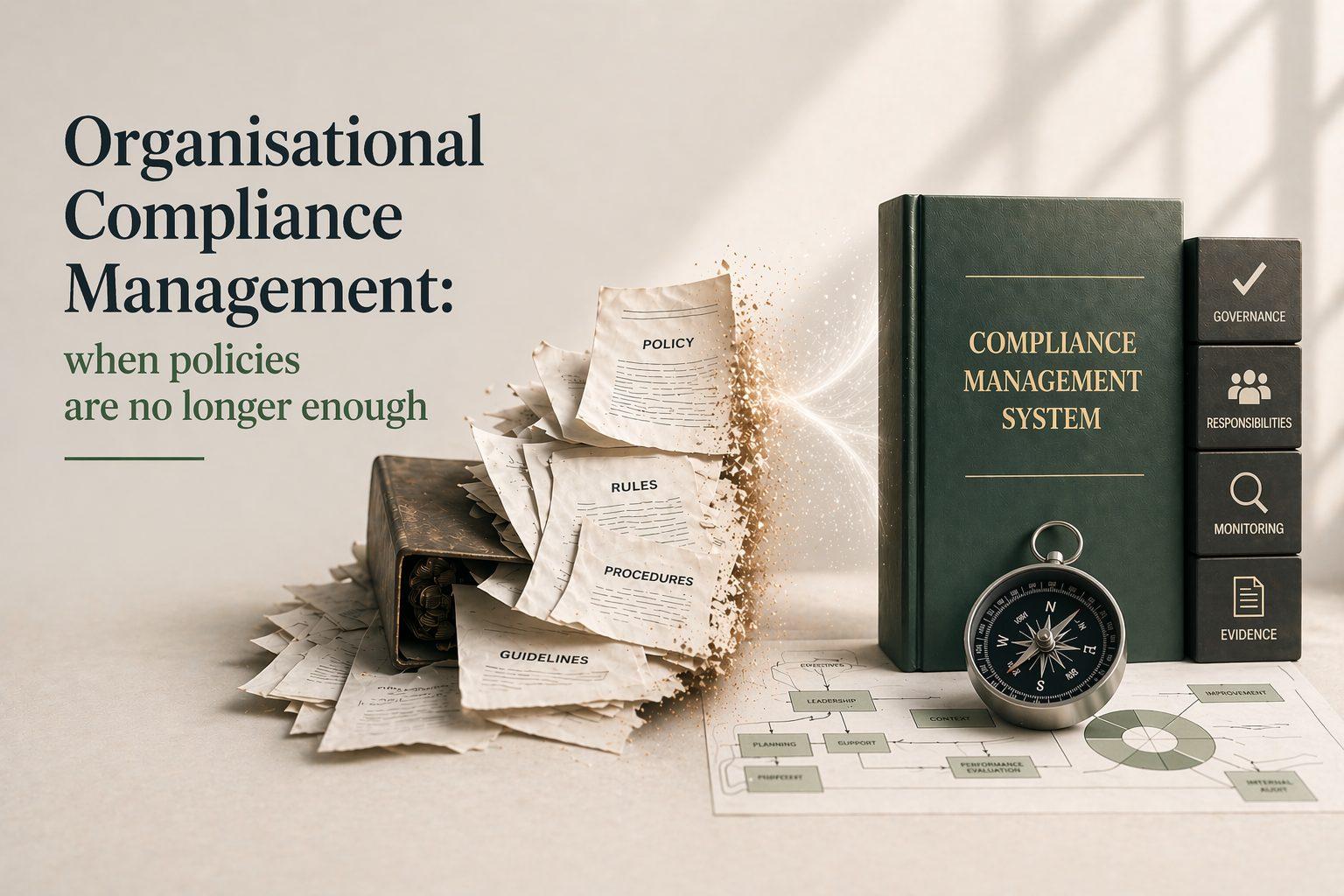
As organisations grow, compliance can no longer rely on isolated initiatives, fragmented decisions and improvised evidence. At this stage, compliance management can no longer depend solely on scattered documentation and begins to require an organisational compliance system capable of ensuring coherence, consistency and evidence.

⏱️ Estimated reading time: 6 minutes

An organisational compliance system becomes essential as organisations grow and compliance can no longer rely on isolated initiatives, fragmented decisions and improvised evidence. For a long time, many organisations were able to operate with a relatively informal approach while still responding to compliance requirements.

Employee Readiness: why organisational maturity can no longer remain concentrated in the hands of just a few people

Employee Readiness_ENG

Employee Readiness: why organisational maturity can no longer remain concentrated in the hands of just a few people

In more regulated, more auditable and more risk-exposed environments, it is no longer enough for critical topics to be defined. They must be understood and applied by those with execution responsibilities.

⏱️ Estimated reading time: 6 minutes

In many organisations, the need for Employee Readiness is already becoming clear. Critical topics have been identified. There are requirements, policies, controls, plans, accountable roles, projects and, in many cases, even specialised functions. Even so, gaps in coordination remain, decisions are delayed, execution is inconsistent, and organisations still struggle to demonstrate that what has been defined is genuinely understood and applied by those with execution responsibilities.

Digital compliance, privacy and cybersecurity: critical skills to respond to real priorities with sound judgement

Digital_compliance_privacy_cybersecurity_Behaviour_Group

Digital compliance, privacy and cybersecurity: critical skills to respond to real priorities with sound judgement

Between GDPR, ISO 27701, NIS 2, cybersecurity and ISO/IEC 27001, organisations need less and less generic awareness and more and more applicable, structured and decision-relevant skills.

⏱️ Estimated reading time: 6 minutes

After several years in which many organisations focused mainly on understanding concepts, mapping obligations and following trends, today’s requirement is different. In areas such as privacy, digital compliance, information security and cybersecurity, it is no longer enough to know the topics in a generic way. It is necessary to interpret requirements, structure responsibilities, apply

New Behaviour courses for 2026: critical skills for real priorities

Novos cursos Behaviour para 2026

New Behaviour courses for 2026: critical skills for real priorities

Behaviour enters 2026 with new courses designed to respond to increasingly concrete organisational demands. Amid regulatory pressure, greater operational maturity, stronger resilience requirements and growing expectations around audit and evidence, it is no longer enough to know concepts: it is necessary to understand priorities, interpret requirements and turn them into real capability.

⏱️ Estimated reading time: 4 minutes

The new Behaviour courses for 2026 emerge precisely in this context. The new offering strengthens critical areas for companies, technical teams, compliance professionals, auditors, risk managers, operational leaders and decision-makers who need to respond more robustly to regulatory, technological and organisational challenges. More than simply expanding the catalogue, this evolution

What distinguishes a diligent response to a cybersecurity incident

Resposta a Incidentes

What distinguishes a diligent response to a cybersecurity incident

Cybersecurity incidents affecting personal data have become a structural risk for organisations with high digital exposure. More than the incident itself, what truly differentiates mature organisations is the way they respond.

⏱️ Estimated reading time: 2 minutes

Responding to cybersecurity incidents is no longer an exceptional topic. In complex, highly integrated and regulated digital environments, the question is no longer whether an incident may occur, but how the organisation is prepared to detect, contain, manage and communicate it responsibly. Cases recently made public in critical sectors of the European economy show that

Between closing the year and preparing the next, there is a period that deserves attention

Between closing the year and preparing the next, there is a period that deserves attention

The end of the year is not just an arrival point. It is an in-between space,
often invisible, where the foundations of future decisions are built.

⏱️ Estimated reading time: 6 minutes

The end of the year brings its own rhythm. Agendas begin to ease, teams move into a more reflective mode and conversations take on a different tone. It is not a time of urgency. It is a time for review, mental organisation and the quiet preparation of what comes next. This in-between period, between the close of one cycle and the start of another, is rarely visible. It does not appear in formal

CISM: The Course That Develops Information Security Leaders

CISM Curso Forma Lideres Segurança da Informação (Instagram)

Information Security • Article

CISM: training Information Security leaders in a real-world context

⏱️ Estimated reading time: 7 minutes

Information Security is no longer just technical.
Today, it requires strategic vision, decision-making ability and informed leadership.

Today, Information Security is more than a technical function; it is a central element of business strategy and business continuity. Organisations are looking for professionals capable of leading, managing, making decisions and aligning security with strategic objectives. Behaviour’s CISM Course was created precisely to train Information Security managers with strategic vision

Continuity by Design: Reducing Concentration Risk in Cloud and Third-Party Dependencies

Reduzir Risco Cloud Terceiros (Instagram)

Continuity & Resilience • Article

After what happened, the question is no longer “what could happen” – it is “how long will it take to restore?”

⏱️ Estimated reading time: 9 minutes

Hyperscaler dependencies, systemic failures and third-party concentration are changing the expectation: proving continuity and recovery capability, with evidence and testing.

After Google Cloud (12/Jun/2025), Microsoft 365 (Jul/2025) and the Iberian blackout (28/Apr/2025), the question is no longer “what could happen” but rather “how long will it take to restore services and serve the customer again?”

The 8 fronts that distinguish those who deliver security

Frentes_entrega_seguranca (Linkedin)

Information Security • Article

The 8 fronts that distinguish those who deliver security

⏱️ Estimated reading time: 8 minutes

In a context of growing demands, maturity is synonymous with trust.

Security is no longer just a technical discipline. Today, it is a direct sign of organisational maturity, of the ability to protect the business and to respond effectively when something goes wrong.

Regulators, customers and auditors want evidence

Provar que protege os dados (Linkedin)

Information Security & Compliance • Article

Regulators, customers and auditors want evidence

⏱️ Estimated reading time: 7 minutes

Implemented controls, treated risks, reported incidents and auditable logs are no longer optional.

Regulators, customers and auditors want evidence: implemented controls, treated risks, reported incidents and auditable logs.

The 7 Most Common Audit Mistakes and How to Avoid Them

7 erros em auditorias (Instagram)

Audit & Governance • Article

Auditing is not just checking whether documentation exists

⏱️ Estimated reading time: 7 minutes

It is about understanding whether there is real control, applied practices and consistent maturity across the organisation.

Auditing is not just checking whether documentation exists. It is about understanding whether there is real control.

Audits are critical moments: they assess whether the organisation is merely “doing the minimum” or whether it has consistent and mature practices.

5 mistakes that ruin a cyber stress test

5 erros teste stress cibernetico

Resilience & Testing • Article

Why testing is necessary – but testing badly can be worse than not testing at all

⏱️ Estimated reading time: 6 minutes

Cyber Stress Tests only create value when they test real decisions, uncertainty and response capability – not when they create false certainty.

Why is testing necessary? But testing badly can be worse than not testing at all

Cyber Stress Tests have become an increasing requirement in sectors such as financial services,
healthcare, digital services and critical infrastructure.

Cybersecurity is not a department. It is a collective responsibility

Ciberseguranca Responsabilidade Coletiva (Instagram)

Culture & Cybersecurity • Article

No firewall can protect against a wrong click

⏱️ Estimated reading time: 7 minutes

True resilience starts with people — and with the culture that sustains secure day-to-day decisions.

No matter how robust the technology may be, no firewall can protect against a wrong click. Cybersecurity is often seen as a technical domain, reserved for specialised teams.
However, the most effective attacks exploit the weakest link of all: human behaviour.

ISO/IEC 27701:2025 — The New Era of Privacy Information Management

A Nova ISO 27701 2025

Privacy & Compliance • Article

ISO/IEC 27701:2025: why is this standard a milestone?

⏱️ Estimated reading time: 10 minutes

The 2025 edition makes ISO/IEC 27701 independent, aligned with Annex SL 2024 and focused on a standalone, certifiable PIMS.

Why is this standard a milestone?

The new edition of ISO/IEC 27701:2025 marks a historic turning point in the way organisations manage privacy.
It is no longer an extension of ISO/IEC 27001 and becomes an independent standard, with its own structure and aligned with the latest version of Annex SL, the 2024 edition.

What Changed with NIS 2 — and Why the Change Can No Longer Be Ignored

O que mudou com a NIS 2 (Linkedin)

NIS 2 & Compliance • Article

The NIS 2 Directive is already in force – and most organisations are still not prepared

⏱️ Estimated reading time: 7 minutes

A turning point in risk management, cybersecurity and incident reporting for essential, important and critical sectors.

The NIS 2 Directive (EU 2022/2555) is already in force across the European Union — and most affected organisations are still not prepared.

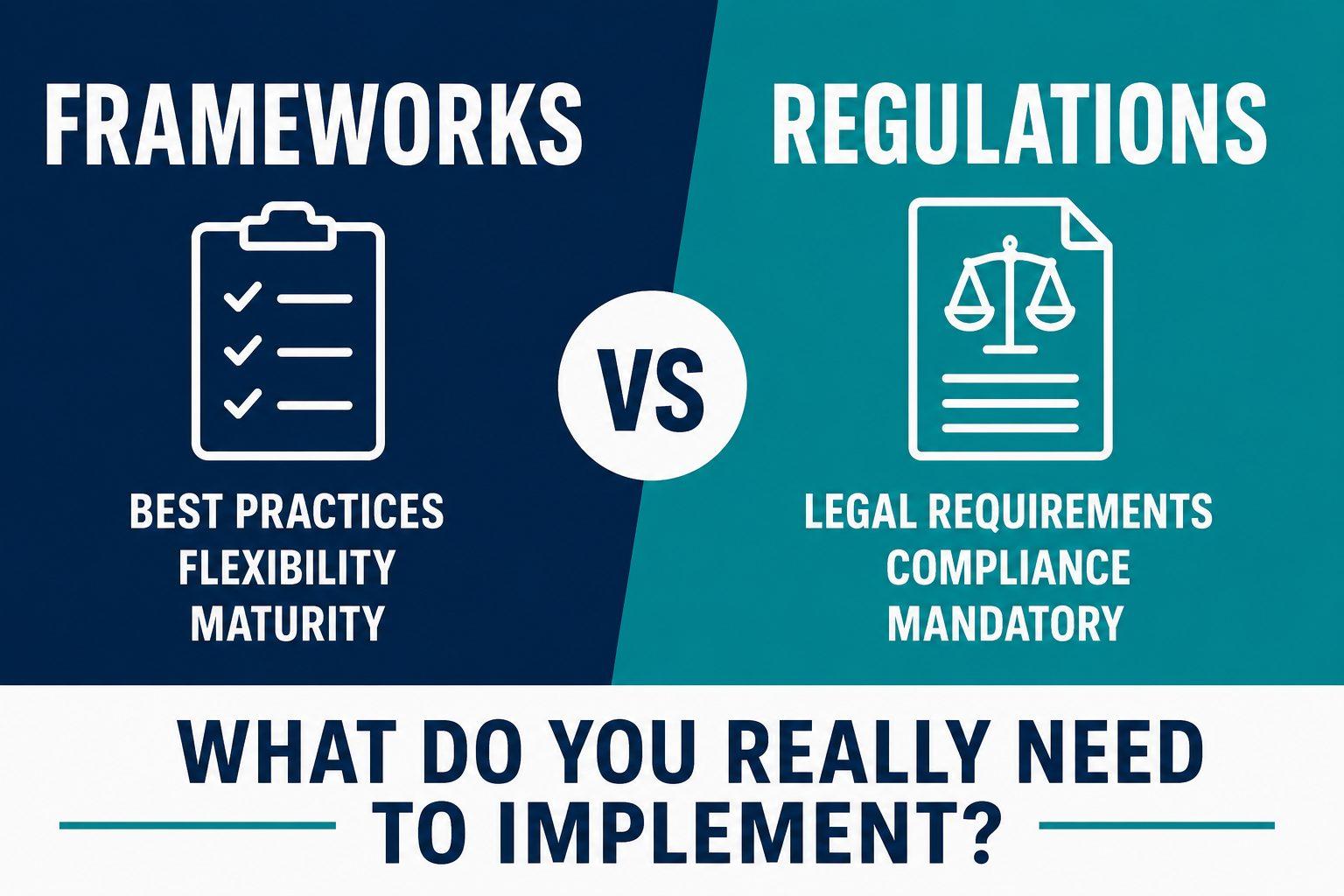
Frameworks vs Regulations: what do you really need to implement?

Frameworks_Regulamentos_realmente_precisa_implementar

Frameworks & Regulations • Article

Frameworks vs Regulations: what to implement and why

⏱️ Estimated reading time: 8 minutes

In a world saturated with standards and rules, the advantage lies in knowing how to integrate what is required with what creates real maturity.

In a world saturated with standards, frameworks, directives and regulations, many organisations face the same question:After all, what should we implement? ISO/IEC 27001? NIST? NIS 2? DORA? Everything?

Business Continuity: risk is no longer a possibility, it has become the new normal

Continuidade_Negocio_Risco_deixou_hipotese_tornou

Continuity & Resilience • Article

Resilience is a daily discipline, not a document left in a drawer

⏱️ Estimated reading time: 8 minutes

Technology incidents and third-party failures continue to prove that continuity is built in practice, every day.

Technology incidents and third-party failures show that resilience is a daily discipline, not a document stored in a drawer.

5 skills every cybersecurity professional needs, and none of them is technical

5 Competências Ciberseguranca_Linkedin

People & Cybersecurity • Article

The 5 non-technical skills that make the difference in cybersecurity

⏱️ Estimated reading time: 6 minutes

Technology is essential, but it is people, decisions and behaviour that determine the real effectiveness of security.

When people think about cybersecurity, many imagine firewalls, encryption, intrusion detection tools or penetration testing. All of this matters, but it is not enough.The truth is that the professionals who work most effectively in cybersecurity bring something more. And that “something more” is rarely taught in technical courses.

October Is Cybersecurity Month: how to turn 31 days of awareness into real protection

Outubro mês da Ciberseguranca_Instagram

Awareness & Phishing • Article

European Cybersecurity Month 2025: focus on phishing

⏱️ Estimated reading time: 9 minutes

A ready-to-use plan to engage employees, measure impact and build capabilities that last beyond October.

This year, the European campaign places the focus on phishing.

Below is a ready-to-use plan to engage employees, measure impact and deliver results that last beyond October.

AI will not replace auditors

inteligencia artificial auditores

AI & Audit • Article

AI will not replace auditors

⏱️ Estimated reading time: 7 minutes

But it will replace those who ignore it.

But it will replace those who ignore it.

Artificial Intelligence is no longer the future; it is the present. It is transforming the way we deal with data, control, decision-making and risk. And auditing is not exempt from that revolution.

How to prepare your organisation for a cyber stress test without panicking

Testes_Stress_Ciberneticos

Resilience & Testing • Article

Cyber Stress Tests: when the organisation is put to the test

⏱️ Estimated reading time: 7 minutes

Simulate, test and demonstrate operational and cyber resilience under realistic pressure.

Cyber Stress Tests are coming. And they are not a passing trend; they are a growing requirement for critical, financial and regulated organisations.

The question that can compromise any continuity plan:

Plano_Continuidade_Negócio_Instagram

Continuity & Resilience • Article

What if your core team is unavailable?

⏱️ Estimated reading time: 6 minutes

Real continuity is measured when the right people are not there and the organisation still manages to respond.

What if your core team is unavailable?

In most continuity or recovery plans, there is a silent but critical error: it is assumed that the right people will be available at the right time.

European Union accelerates the regulation of Artificial Intelligence

Uniao_Europeia_Inteligencia_Artificial_Behaviour_Instagram

Artificial Intelligence & Regulation • Article

The AI Act is redefining the digital economy

⏱️ Estimated reading time: 6 minutes

And qualified professionals are becoming a central part of the new digital economy.

And qualified professionals are becoming a central part of the new digital economy

In a context of accelerated growth in global cybersecurity investment, expected to reach 213 billion dollars in 2025, according to IDC forecasts, the European Union is consolidating its regulatory framework to ensure that Artificial Intelligence evolves with security, responsibility and transparency.

The new AI Act (Regulation 2024/1689) places Europe at the forefront of ethical AI governance and establishes concrete obligations for public and private organisations across the entire value chain.

This scenario creates a new urgency: the need for qualified professionals who understand not only the potential of AI, but also its legal, operational and ethical implications.

What is at stake with the AI Act?

The AI Act is the European Union’s first horizontal regulation on Artificial Intelligence.
Its main objectives include:

  • Prohibiting unacceptable AI systems (e.g. social scoring, behavioural manipulation)
  • Regulating high-risk systems (e.g. AI applied to healthcare, transport, finance, education or justice)
  • Requiring assessment, transparency and control over systems integrated into critical products or services
  • Assigning clear responsibilities to providers, importers, distributors and users
  • Creating a new market for auditors, conformity assessors and AI governance professionals

The AI Act enters into force in phases, but companies need to start preparing now.

Global investment is growing, and so is exposure

As the world invests increasingly in cybersecurity, cloud and intelligent automation, Europe is taking a decisive step by requiring AI solutions to be auditable, explainable and aligned with democratic values.

Organisations will need:

  • Qualified AI implementers and auditors
  • Risk and compliance managers capable of applying the AI Act
  • Teams with digital, legal, technical and ethical AI literacy

How Behaviour is preparing the professionals of the future

Behaviour is a pioneer in Portugal in creating a structured training programme in Artificial Intelligence based on international standards and European legislation.

All courses are practical, professionally oriented and updated with the AI Act, ISO/IEC 42001 and the principles of responsible AI governance.

Available courses:
  • AI Act Foundation
    Introductory course on the European AI Regulation (2024/1689)
    For IT, compliance, legal, security or management professionals who need to understand the impact of the new European regulation.
  • ISO/IEC 42001 Foundation
    The first course in Portugal on the ISO/IEC 42001 – Artificial Intelligence Management Systems standard
    It covers technical requirements, ethical principles, organisational controls and governance structure.
  • ISO/IEC 42001 Lead Implementer
    Advanced and practical course for those who will lead the implementation of ISO/IEC 42001 within an organisation.
    It includes risk management, applied ethics, governance, technical controls and response plans.
  • ISO/IEC 42001 Lead Auditor
    Complete preparation to conduct audits of AI management systems based on ISO/IEC 42001.
    It includes audit techniques, evidence analysis, simulations and practical alignment with the AI Act.
Who are these courses for?
  • IT, information security and risk management professionals
  • Lawyers and compliance officers
  • Consultants and implementers of AI systems
  • Systems, quality, ESG and cybersecurity auditors
  • Innovation, digital transformation and organisational ethics managers

Artificial Intelligence is already present in organisations.
Now it must also be in the hands of those who know how to govern, implement and audit it responsibly.

With Behaviour, professionals prepare themselves with technical knowledge, strategic vision and direct alignment with the European Union’s requirements. Because the future of AI is not only a matter of innovation, it is a matter of trust.


Author: Behaviour
Published on: 20 August 2025
Copying or reproduction of this article is not authorised.


ISO/IEC 27001 Information Security with Behaviour

Seguranca_Informacao_com_Behaviour_Linkedin

Information Security • Article

ISO/IEC 27001 Training: real preparation to lead

⏱️ Estimated reading time: 7 minutes

Far more than training, it is real preparation for those who want to lead in information security.

Far more than training, it is real preparation for those who want to lead in information security

The ISO/IEC 27001:2022 standard is now the global reference for those who want to protect assets, manage risks and build trust in information systems. But learning the standard is not enough. It is necessary to know how to apply it, audit it and update it, and to do so with method, confidence and results.

At Behaviour, we believe that training only makes sense if it turns knowledge into practice.
That is why every ISO/IEC 27001 course we offer goes beyond theory and prepares participants to act in the real world.

Which courses are available?

1. ISO/IEC 27001 Foundation

Ideal for those who want to understand the principles of the standard, even without previous experience.

  • Fundamental ISMS concepts
  • Structure and clauses of ISO 27001:2022
  • Introduction to Annex A and its link with ISO/IEC 27002:2022
  • Alignment with legal requirements and best practices
  • Support documentation created with the learners for immediate application

Recommended for technical teams, operational staff or decision-makers who need to master the foundations clearly and in an applied way.

2. ISO/IEC 27001 / ISO/IEC 27002:2022 Transition

Training aimed at those who already know the previous versions and/or hold a Behaviour certification in the 2013 edition
and need to adapt the ISMS to the requirements of the new edition or transition their Lead Implementer or Lead Auditor certification to the new edition.

  • Changes in the normative clauses and in the structure of Annex A
  • New categorisation of controls: organisational, people, physical, technological
  • ISO/IEC 27002:2022 attributes and topic-based view
  • Practical impact on auditing and implementation
  • Transition checklist + impact matrix adaptable to each organisation

Ideal for consultants, auditors, security managers or compliance officers with active systems.

3. ISO/IEC 27001 Lead Auditor

Advanced and certified training for those who want to audit with excellence, lead teams and contribute to the continuous improvement of the ISMS.

  • Audit techniques according to ISO 19011:2018
  • Planning, conducting, concluding and following up internal and external audits
  • Evidence analysis, interviews, nonconformities and corrective actions
  • Connection with standards, regulations and frameworks (NIS 2, DORA, NIST CSF)
  • Creation of real audit documents during the course (plans, checklists, findings records and reports)

Recommended for professionals with or without experience who want to prepare for and/or act as lead auditors with technical command and strategic vision.

4. ISO/IEC 27001 Lead Implementer

A complete course for those who want to implement and maintain an Information Security Management System (ISMS)
in conformity with ISO/IEC 27001:2022.

  • Practical interpretation of all normative requirements
  • Real application of Annex A controls (based on ISO/IEC 27002:2022)
  • Integration with risk management, continuity, privacy and organisational culture
  • Development of policies, plans, records and procedures based on practical cases
  • All essential documents for a functional ISMS are built in class with the participants

Suitable for those who hold or intend to hold responsibility for leading ISMS implementation: technicians, managers, consultants, CISOs or compliance leads.

Practical courses, with concrete results

All Behaviour ISO courses follow a 100% practical and applied approach:

  • Real exercises based on case studies and simulations
  • Resolution of concrete problems faced by organisations
  • Documentation created in class for immediate use at work
  • Trainers with real-world experience, not only theory
  • Continuous support during and after the training

Learners leave with documents and templates ready to adapt, useful for internal audits or real consultancy projects.

What you gain with Behaviour

  • Up-to-date technical rigour
    Training 100% aligned with the 2022 versions of ISO/IEC 27001 and 27002, with direct connection to the most demanding regulations (NIS 2, DORA, CRA, GDPR).
  • Mastering Best Practices methodology
    We do not only teach the standard. We teach how to turn it into real and effective practice, connected to the reality of teams, processes and risks.
  • Professional certification with clear progression
    All training courses include Behaviour certifications issued in accordance with the international standard ISO/IEC 17024 and positioned by levels (Foundation, Transition, Lead Auditor, Lead Implementer).

Who are the courses for?

  • Information security technicians and managers
  • Consultants and internal/external auditors
  • IT, risk and compliance professionals
  • Those responsible for the ISMS or for audit readiness
  • Teams that want to structure, review or improve their system

Training and Certification that serve for today and tomorrow

The standard is here. The risks are too. What changes is the quality of your preparation. At Behaviour, courses do not exist only to teach; they exist to ensure people know how to do.

Behaviour-certified professionals are subject to a demanding assessment process, including a challenging evaluation exam and a rigorous scrutiny of their professional experience and capabilities (for applicable certifications under ISO/IEC 17024 requirements).


With Behaviour, you do not just take away a certificate. You take away real capability, documents ready to apply, the confidence of someone who knows what they are doing, and a certification that validates competence, not only knowledge.


Author: Behaviour
Published on: 18 August 2025
Copying or reproduction of this article is not authorised.


CRISC Course – Become a leader in information systems risk and control management

Curso_CRISC_Linkedin

Risk Management • Article

CRISC Training: manage risk with clarity, control and vision

⏱️ Estimated reading time: 6 minutes

Intensive and immersive training for those who want to lead risk decisions in information systems.

Intensive and immersive training for those who want to manage risk with clarity, control and vision

The CRISC certification is now an international benchmark for professionals who manage risk in information systems
and who play an active role in strategic governance and control decisions.

At Behaviour, preparation for the CRISC exam goes beyond the content.


With Behaviour, you will master the four CRISC domains with confidence, structure and real-world application.

What you will learn

Throughout Behaviour’s CRISC course, you will explore in depth the four major domains of the certification programme:

1. Enterprise Risk Governance
– Integration of risk into strategy, organisational culture and decision-making.

2. IT Risk Assessment
– Identification, analysis and evaluation of risks related to information systems.

3. Risk Response and Mitigation
– Planning and implementation of effective responses aligned with business objectives.

4. Risk and Control Monitoring and Reporting
– Ongoing oversight, effectiveness metrics and communication with stakeholders.

All topics are covered through real examples, simulation exercises for exam preparation, visual support maps and mock exams.

With Behaviour, you will…

  • Study with method, not under pressure
    The training is organised into logical blocks, with clear explanations, visual summaries
    and review questions at the end of each domain.
  • Practise with people who know the field
    Experienced, certified trainers with deep knowledge of the concepts
    and of the reality faced by those working with risk and controls in IT.
  • Prepare for the exam with confidence
    We include exercises and a mock exam, techniques to manage exam time
    and tips to strengthen applied reasoning in line with the style of the questions.
  • Gain access to a set of genuinely useful study materials
    Access a set of supporting documents (diagrams, comparison tables, glossaries,
    framework examples and guidance on accessing additional valuable resources)
    that you can reuse in your daily work.

Who should attend the CRISC course?

  • Risk managers
  • IT and information security leaders
  • Information systems consultants and auditors
  • Professionals working in compliance, governance or continuity teams
  • Candidates for the international CRISC certification seeking solid and practical preparation

Concrete benefits of the training

  • Complete command of the content required for the exam
  • Real capability to apply risk management frameworks
  • Preparation to operate in complex contexts, with multiple stakeholders
  • Professional recognition in one of the most sought-after profiles in the market

Organisation and support

The course is intensive, with an optimised workload to accelerate preparation without losing depth.
It includes moments of individual assessment, question-and-answer sessions
and access to post-course support, should you need to reinforce your preparation before the exam.


Ready to progress in risk management?

With Behaviour, you gain more than exam preparation — you gain the confidence to act with assurance.
You gain structure, clarity and the ability to make decisions that truly protect the business.

Secure your place now and prepare with those who take certification seriously.


Author: Behaviour
Published on: 13 August 2025
Copying or reproduction of this article is not authorised.


Security During the Holiday Period

Seguranca Periodo Ferias

Security & Continuity • Article

Essential precautions for professionals and teams that cannot give risks a holiday

⏱️ Estimated reading time: 7 minutes

Practical preparation to protect information security, business continuity and organisational resilience during the holiday period.

August has arrived. For many, it is a time to rest. For risks, it is an opportunity. When we switch into summer mode, we relax, teams rotate and processes slow down. But risks remain alert. It is precisely during these periods of lower vigilance that many of the most serious incidents begin. Below, we share the main precautions to take before, during and after the holiday period, with a focus on information security, business continuity and organisational resilience.

Before the holidays: prepare, protect, delegate

1. Review and limit accounts and access

  • Remove temporary or unused access
  • Review permissions assigned to external providers
  • Restrict privileged access and ensure traceability
  • Apply clear rules for governing bodies, where necessary
  • Record everything — future deactivation and reactivation actions

Minimum access. Limited time. Everything traceable.

2. Define substitutes and clear procedures

  • Who replaces whom?
  • What decisions may be taken?
  • What should be done in the event of an incident?

Continuity is not only presence — it is preparation and response.

3. Strengthen vigilance against fraud and phishing

  • Urgent payments allegedly requested in the name of an absent CEO
  • Fake requests to change an IBAN
  • Urgent messages threatening penalties
  • Fake prizes or competitions
  • Fraudulent delivery links
  • Beware of deepfakes: fake voice or video messages requesting access, transfers or extortion payments

Stay extra alert. Apply cyber hygiene. Always report.

4. Review continuity and incident response plans

  • Are the plans updated and tested with a reduced team?
  • Who activates the plan in August?
  • Do suppliers remain ready during that period?

A plan that does not work during the holiday period… is not a plan.

During the holidays: keep the essentials working

5. Be careful with public networks and Wi-Fi

  • Switch off networks and equipment that are not needed
  • Avoid public Wi-Fi when accessing systems
  • If unavoidable, use the organisation’s VPN

Today’s convenience may become tomorrow’s incident.

6. Protect and automate without switching off completely

  • Automate backups (preferably immutable)
  • Activate alerts and notifications for incidents
  • Ensure minimum visibility even during holidays

Smart automation protects even when you switch off.

7. Avoid exposing your absence on social media

  • Avoid phrases such as “away until September”
  • Avoid photos and videos with real-time location
  • Prefer closed groups for personal sharing

A larger digital footprint means more opportunity for social engineering attacks.

After the holidays: validation and reactivation

8. Revalidate access and changes made

  • Is any temporary account still active?
  • Were any settings changed without being reversed?
  • Was any incident not detected?
  • Review logs and security reports

Post-holiday period = mandatory check-up.

9. Update and validate systems

  • Apply pending security updates
  • Check backups and reports
  • Confirm the integrity of logs, including antivirus and firewall logs

Start with confidence. Without technical doubts.

Recommended training?

Behaviour helps teams anticipate risks, respond to incidents and strengthen continuity before, during and after the holiday period.

Recommended courses:

Preparation is protection. Even when everyone else is switching off. Security does not take holidays. But with the right planning, you can.

View training calendar


Author: Behaviour
Published on: 4 August 2025
Copying or reproduction of this article is not authorised.


ISO 27001 Lead Implementer: Training for those who want to lead information security with confidence

ISO 27001 LI Linkedin

Information Security • Article

ISO/IEC 27001 Lead Implementer: leading implementation with real impact

⏱️ Estimated reading time: 7 minutes

Implement, adapt and demonstrate value to the business through ISO/IEC 27001.

In a world where risks are multiplying and information is one of the most valuable assets of organisations, the ISO/IEC 27001 standard has become the international reference for protecting data, systems and critical processes. But implementing this standard effectively, and truly leading its adoption, requires more than knowing the requirements. It requires vision, competence and the ability to execute.

That is exactly why the Behaviour ISO 27001 Lead Implementer course exists: an immersive, demanding training programme focused on real results.

Far more than simply complying with the standard, you will learn how to implement and adapt a holistic model for information security management capable of responding, proportionately, to an organisation’s needs, balancing risk exposure and the selection of controls at an optimal cost.

From the need for agile business strategies in an increasingly competitive global market, to the new challenges of the current geopolitical context, the new and demanding legal and regulatory requirements, and the new normal of emerging technologies and the uncertainty of new related risks.
Investing in information security is investing in the business itself; it is investing in the capability of teams. It means being able to defend, justify and demonstrate to the business the value of every investment and every decision.


Being able to demonstrate to the business the benefits of its investment, while optimising risk and the use of resources, is what it means to deliver value through the implementation and operation of ISO/IEC 27001.

In this Behaviour course, you will not only learn how to implement; you will prepare yourself to respond to the greatest challenge in information security: learning how to deliver value to the business through ISO/IEC 27001.

Far beyond theory

With Behaviour, you go far beyond theory.
You will understand why each clause exists,
how it connects to real risks,
and how it can (or should) be applied to the specific reality of each organisation.

You will develop the ability to:

  • Identify and interpret the requirements of ISO/IEC 27001:2022 with clarity;
  • Conduct risk assessments and define the appropriate controls;
  • Plan, implement and manage an Information Security Management System (ISMS);
  • Prepare the organisation to respond to internal and external audits;
  • Integrate complementary best practices from standards such as
    ISO/IEC 27002 and ISO/IEC 27005.

All of this takes place in a learning environment led by trainers with practical experience and focused on the real transfer of knowledge, and acquired practice, to leadership in implementation projects.

What you can expect from this training

  • Practical analysis of ISO/IEC 27001:2022, aligned with the latest versions;
  • Applied exercises, document examples and analysis of real implementation cases;
  • Preparation to respond to audits and move forward towards ISO/IEC 27001 certification;
  • A step-by-step methodology, with tools, models and technical support throughout the training;
  • An environment where learning is supported, practical, challenging and focused on real-world application.

With Behaviour, you will:

  • Understand the foundations of the standard and its application in a structured and practical way;
  • Understand and recognise the technical, operational and cultural challenges of implementation;
  • Develop the ability to plan and execute ISMS projects with autonomy;
  • Work with demanding, up-to-date content designed to support your learning and practical application;
  • Be part of a training experience that values your professional journey and strengthens your professional authority.

Who is this training for?

  • Information security, compliance, risk and IT professionals who want to lead ISO/IEC 27001 implementation projects;
  • Managers and consultants who want to apply the standard with confidence in real environments;
  • Technical professionals seeking to develop a complete view of all the requirements and controls of the standard;
  • Those who want to obtain a solid professional certification based on demanding and respected training.


Leading the implementation of ISO/IEC 27001 is a serious responsibility and a clear competitive advantage.

If you want to prepare yourself with rigour, support and a methodology that takes you further, this is the right training for you.

Develop these capabilities with our training:

At Behaviour, we create courses that do not simply train technicians. They develop professionals with vision, ethics, critical thinking and leadership. This training is delivered in Portuguese or English.


Author: Behaviour
Published on: 29 July 2025
Copying or reproduction of this article is not authorised.


CISSP: Training for Professionals Who Take Security Seriously

Artigo CISSP

Cybersecurity & Leadership • Article

CISSP Course: understand, apply and lead information security

⏱️ Estimated reading time: 6 minutes

A benchmark training course for those who want to go beyond the exam and transform the way they work in information security.

In a constantly changing environment, where risk scenarios are becoming increasingly sophisticated, information security has stopped being a support function and has become a strategic area.
Organisations demand excellent professionals with the capabilities to anticipate threats, protect critical assets and lead with confidence.
That is where Behaviour’s CISSP course comes in: a benchmark training course, complete and designed for those who do not want merely to pass the exam, but to learn and transform the way they work in information security. 

More than studying: understand, apply, lead

The Behaviour CISSP course was designed to prepare demanding professionals for the most complex cybersecurity challenges. With Behaviour, you go far beyond mechanical memorisation.

You will build a solid understanding of the critical concepts in each domain, understanding why each principle matters, how it applies, and why it has to be done that way and not another. This is conscious learning, focused on clarity, logic and practical application, and not merely on the need to succeed in the exam.

Here, each domain is addressed with depth and practical meaning. You will understand the critical concepts, know how to apply them to real contexts and develop the perspective needed to lead security projects with authority.


What makes this training unique

  • Rigorous depth across the 8 domains of knowledge required for the international certification;
  • Clear and contextualised explanations, with a focus on management, audit, architecture and security operations roles;
  • Exam preparation strategies, focused on what matters, without shortcuts;
  • Discussion of exercises, practical cases and frequent traps, to consolidate reasoning and avoid common mistakes;
  • Support from a recognised trainer, with national and international experience, and a close and effective pedagogical approach.

With Behaviour, you go further

This is not training designed just to fill a schedule. It is a complete learning experience, rigorous, engaging and focused on concrete results.

  • You will master the technical and management foundations that support major cybersecurity decisions;
  • You will work with organised, up-to-date and adapted content designed to facilitate understanding and exam success;
  • You will take part in an immersive and stimulating environment, where learning is supported and guided, and where questions are addressed with clarity;
  • You will receive continuous support, with complementary materials, study strategies and real guidance — even after the training.

Who is this training for?

  • Professionals who work (or intend to work) as CISOs, information security managers, consultants, auditors, architects or risk analysts;
  • Those who want to consolidate an international career with one of the most valued certifications in the sector;
  • Those seeking serious training, with depth, rigour and real career impact.


At Behaviour, we prepare professionals to make a difference

If you are ready to take information security to a new level, this is the right training.

Author: Behaviour
Published on 23 July 2025
Copying or reproduction of this article is not authorised.


Business Continuity Plan (BCP) Components: Ensuring resilience in the face of disruptive events

Business Continuity • Article

The essential components of a Business Continuity Plan (BCP)

⏱️ Estimated reading time: 9 minutes

How to structure a robust BCP to respond to disruptive events, protect assets and ensure organisational resilience.

In today’s business world, where organisations face complex interconnections and an environment in constant evolution, a disruptive event may occur at any time and threaten the very existence of an organisation.
Events such as natural disasters, cyberattacks, pandemics and other types of crisis scenarios may cause
significant damage to a company’s operations, reputation and financial results.
To mitigate these risks, organisations should develop a comprehensive Business Continuity Plan (BCP) that sets out the procedures and strategies required to maintain business operations during and after a disruption. A properly designed BCP is essential to ensure an organisation’s resilience, protecting its assets and minimising the impact of disruptions on its customers, employees and stakeholders. In this article, we address the main components of a Business Continuity Plan, providing a comprehensive view of the essential elements that organisations should include in their BCP.

1. Business Impact Analysis (BIA)

The first step in developing a BCP is to carry out a Business Impact Analysis (BIA). This involves identifying critical business processes, assessing the potential impact of a disruption on those processes and prioritising their recovery.
A BIA helps organisations understand the potential consequences of a disruption, including financial losses, reputational damage and loss of customer trust.

As part of the BIA process, the organisation will identify business continuity objectives, which support the definition of the goals and objectives of the BCP, including recovery time objectives (RTOs) and recovery point objectives (RPOs).
RTOs define the maximum time required to recover critical business processes or functions, while RPOs define the maximum amount of data that can be lost during a disruption.
These objectives will be important so that, at a later stage, it becomes possible to select and establish the business continuity and disaster recovery strategies that will be included in the BCP.

2. Risk Assessment

Risk assessment is a critical component in establishing a BCP, as it helps organisations identify potential risks that may disrupt business activities, impacting critical processes, resources and other interdependencies, such as, for example, an information technology supplier that forms part of the supply chain.

This includes identifying potential natural disasters, cyberattacks, failures or breakdowns in critical infrastructure and other types of disruptive events that may affect the organisation. A risk assessment will also help organisations prioritise the development of mitigation strategies and contingency plans, making it possible to reduce the likelihood of disruptive events and prepare the capabilities required for a rapid response and the consequent reduction of impacts.

3. Business Continuity and Recovery Strategies

3.1 Business Continuity Strategy

The business continuity strategy describes the organisation’s approach to maintaining business operations in the event of disruptions. This includes identifying alternative processes, procedures and resources that may be used to maintain business continuity. Business continuity strategy(ies) help organisations develop a plan to respond to disruptive events, minimising downtime and ensuring the continuity of critical business processes.

3.2 Recovery Strategy

Although ensuring business continuity is fundamental, it is also necessary and relevant to consider how to recover critical business functions. The organisation should define a recovery strategy in order to set out the steps required to restore critical business functions to the new “business-as-usual”.

Such strategy(ies) may involve the activation of recovery teams, coordination with previously identified external parties, contact with insurers, the recovery of systems and data from backups, and other actions required to ensure a return to the “new normal”.

4. Business Continuity Operational Plan (BCOP)

The Business Continuity Operational Plan (BCOP) ensures the continuity of the operations of each business area in the event of a disruption or crisis, minimising the impact on customers, employees and other stakeholders. This plan describes the procedures and protocols to be followed in the event of a disruptive incident, ensuring the rapid recovery of operations and the preservation of the organisation’s reputation.

5. Emergency Management Plan

An emergency management plan sets out the procedures for responding to scenarios that represent an immediate threat to life, property or the environment. Its main focus is to ensure people’s safety and minimise damage to property and the environment.

  1. Emergency response procedures
  2. Evacuation plans
  3. Communication protocols
  4. Resource allocation and deployment
  5. Damage assessment and recovery strategies
6. Recovery Plan

The recovery plan sets out the steps required to restore the normal state of the organisation’s operations after a disruptive event, minimising downtime and ensuring the continuity of critical business processes.

7. Crisis Management Plan and the CMT

7.1 Crisis Management Plan

The crisis management plan sets out the procedures for managing scenarios that may significantly damage an organisation’s reputation, finances or operations.

  1. Identification and assessment of the crisis scenario
  2. Development of a response strategy
  3. Communication with stakeholders
  4. Mitigation of the impact of the crisis
  5. Restoration of normal operations and reputation

7.2 Crisis Management Team (CMT)

The crisis management team coordinates, responds to and manages disruptive events, involving representatives from several areas of the organisation, with clearly defined roles and responsibilities.

8. Training and Awareness

Training and awareness ensure that all team members understand the BCP, their roles and responsibilities, reinforcing the importance of business continuity.

9. Testing and Exercising

Testing and exercising the BCP makes it possible to validate its effectiveness, identify gaps and prepare teams to respond with confidence.

10. Monitoring, Review and Continual Improvement

The BCP should be reviewed and updated regularly, ensuring that it remains effective and aligned with the reality of the organisation and its risk context.

11. Other Sub-plans

11.1 IT Disaster Recovery Plan (IT DRP)

Defines procedures for restoring IT systems and data in the event of a disaster, minimising downtime and data loss.

11.2 Communication Plan

Ensures clear, timely and transparent communication with employees, customers, suppliers and other stakeholders during a disruption.

11.3 Supply Chain Continuity Plan

Defines measures to ensure supply chain continuity in crisis scenarios.

11.4 Human Resources Plan

Focuses on the safety, wellbeing and management of employees during and after a disruptive event.

11.5 Financial Plan

Defines procedures to ensure the continuity of financial operations in crisis scenarios.

Conclusion

To ensure the continuity of business operations in the event of a disruption, it is essential to establish a comprehensive Business Continuity Plan (BCP). A well-designed BCP strengthens resilience, reduces the impact of unexpected events and increases stakeholder confidence.

Behaviour offers a catalogue of training and certification dedicated to the area of Best Practices, Methodologies and Management Systems.
Explore the Training Catalogue and the courses in the Business Continuity Area.

Author: Behaviour
Published on: 6 December 2024
Copying or reproduction of this article is not authorised.


Building Robust Systems: The Key to Withstanding Disruptions

Business Continuity • Article

Business Continuity: Building Robust Systems to Withstand Disruptions

⏱️ Estimated reading time: 9 minutes

Best practices and practical tips to prepare the organisation for disruptive events and recover effectively.

In today’s business environment, where organisations face complex interconnections and a constantly evolving context, disruptive events are increasingly likely and form part of the scenarios for which an organisation must be prepared.Whether it is a natural disaster, a cyberattack or a supply chain failure, the impact on your business can be significant. But what if you could build a system capable of withstanding and recovering smoothly from those disruptive events? Let us explore the importance of business continuity best practices and provide practical tips on how to build robust systems that can withstand any “storm”.

Why is business continuity important?

Business continuity means ensuring that your organisation can continue to operate effectively even when faced with unexpected disruptive events. It is about having a plan in place to minimise downtime, protect your reputation and return business operations to normal as quickly as possible. In today’s digital era, the risks are higher than ever. A single hour of downtime can result in significant financial losses, damage to your brand and loss of customer trust.

Consequences of disruptive events

Disruptions can take many forms, from natural disasters such as hurricanes and earthquakes to cyberattacks or supply chain failures. The consequences can be devastating, including:

  • Financial losses: Disruptions can result in significant financial losses, including lost revenue, damaged equipment and increased costs.
  • Reputational damage: a disruption can damage your reputation and affect customer trust, making recovery more difficult.
  • Compliance issues: Disruptions can also lead to compliance issues, including non-compliance with regulatory requirements.
Building Robust Systems

How can you build a system that can withstand and recover from disruptive events? Below are some practical tips:

  1. Develop a Business Continuity Plan: A business continuity plan is a critical component of any robust system. This plan sets out the steps you should take to respond to a disruption, including emergency contact information, backup systems and recovery procedures.
  2. Identify Critical Systems: Identify the critical systems that are essential to your business operations. This may include IT systems, supply chain management and customer support.
  3. Implement Redundancies: Implement redundancies in your critical systems to ensure they continue to operate even if one system fails.
  4. Conduct regular testing: conduct regular tests of your business continuity plan to ensure that it is effective and that your team is prepared to respond to a disruptive event.
  5. Stay informed: stay informed about possible disruptive event scenarios, including natural disasters, cyber threats and supply chain issues.
Examples of real cases

In practice, what are robust systems? Below are some examples of real cases:

  • Delta Airlines: After a critical power failure in 2016, Delta Air Lines was able to recover its operations quickly thanks to its business continuity plan. The airline managed to reroute flights and provide updates to customers, minimising the impact of the disruption.

Unfortunately, Delta Air Lines, and many other companies around the world, were not prepared for an “unthinkable” and “unlikely” scenario and were unable to adapt and respond quickly to the most recent disruptive IT event at the beginning of 2024, caused by the CrowdStrike update.

According to the avweb.com website,
“Delta Air Lines CEO Ed Bastian criticised cybersecurity company CrowdStrike and software provider Microsoft, reporting that the IT disruption cost the airline US$ 500 million.

Delta’s massive computer disruption on 19 July interrupted the airline’s crew tracking system for almost a week, preventing the company from locating pilots and flight attendants to operate flights. As a result, Delta had to cancel around 30% of its flights. (…)

Bastian said Delta’s recovery was significantly hindered due to its high dependence on CrowdStrike and Microsoft for cybersecurity. The company had to manually reinstall 40,000 servers to restore operations.”

  • UPS: When a massive cyberattack hit UPS in 2017, the company was able to respond quickly thanks to its business continuity plan. The company managed to contain the attack and minimise the impact on its operations.
  • NHS: When a major cyberattack hit the NHS and social care in 2022, it caused significant disruption across many care service software systems. One healthcare provider was among the many providers forced to operate without a critical system installed to support its service. Although the provider had all the relevant and appropriate cybersecurity infrastructure in place, the service was disrupted by a targeted ransomware attack against its software supplier. Fortunately, the company had a business continuity plan in place that included a robust cybersecurity plan, and the service was able to continue operating thanks to the practices established in its business continuity plan.

Conclusion
Building robust systems that can withstand and recover from disruptions is essential to the success of any business. By developing a business continuity plan, identifying critical systems, implementing redundancies, carrying out regular testing and staying informed, it is possible to minimise the impact of disruptions and ensure that your business continues to operate effectively. Remember that business continuity is not just about avoiding downtime; it is about protecting your reputation, minimising financial losses and ensuring that your customers continue to trust you.

In addition, business continuity helps to create a culture of resilience so that the organisation is prepared to respond to the most “unthinkable and unpredictable” scenarios. In this way, the company can adapt and respond quickly to such situations, minimising the impact on the business.

Behaviour offers a training and certification catalogue dedicated to the area of Best Practices, Methodologies and Management Systems. Explore the Training Catalogue and the courses in the Business Continuity Area.

Author: Behaviour
Published on: 6 December 2024
Copying or reproducing this article is not authorised.

Disclaimer
: this article is based on public external research gathered from various sources. The information provided is for reference purposes only, and users assume full responsibility for relying on it. BEHAVIOUR accepts no responsibility for the accuracy of this information or for any consequences arising from its use.


10 Essential Areas for Information Security Professionals

Information Security • Article

10 essential areas for Information Security professionals

⏱️ Estimated reading time: 8 minutes

Key capabilities that all Information Security professionals should develop in order to lead effectively.

10 Essential Areas that ALL Information Security Professionals Should Develop to Become Better Managers

Information Security professionals who aspire to become effective managers must possess a diverse set of skills and knowledge. If that is your goal, here are the 10 essential areas that can help you stand out in management roles:

1. Strategic Vision
Information Security managers must develop a strong strategic vision for their organisation’s security posture. This involves understanding the company’s overall business objectives and aligning security initiatives with those objectives. A successful Information Security manager knows how to anticipate new and emerging threats and design proactive strategies to address them.

2. Risk Management
Mastering risk management is crucial for Information Security managers, as they need to identify and analyse risks, determine whether the level of risk falls within the organisation’s acceptance criteria, and support the planning and implementation of controls. This capability makes it possible to better understand and respond to the organisation’s security needs in alignment with business objectives, transforming potential risk scenarios into opportunities for the business.

3. Communication Skills
Effective communication is essential for Information Security managers, who must be able to communicate technical concepts in a simplified way to non-technical stakeholders, including executives and board members. By building strong relationships across departments, they ensure that information security is integrated into the organisation’s processes.

4. Technical Knowledge
Although Information Security managers do not need to be experts in every technical aspect, they should have a solid understanding of core ICT technologies and emerging concepts. This knowledge enables them to make informed decisions, lead teams effectively and assess security measures reliably.

5. Adaptability
The cybersecurity landscape is constantly evolving, requiring Information Security managers to have the ability and flexibility to adapt to change. They must therefore keep up to date with the latest threats, best practices and advanced technologies, adjusting their strategies to current business needs.

6. Leadership and Team Building
Information Security managers must be able to motivate their teams, which involves setting expectations, providing support and guidance, and fostering a culture of information security awareness. Effective leaders also focus on talent development, aligning human capital with the organisation’s strategic objectives, promoting competitiveness, innovation and long-term sustainable success.

7. Compliance Knowledge
Having up-to-date knowledge of compliance matters is essential for Information Security managers, who must be familiar with relevant legislation, directives, standards and frameworks, such as NIS 2, DORA, GDPR, PCI, ISO/IEC 27001 and ISO/IEC 27701. This knowledge makes it possible to ensure the implementation of the necessary measures and compliance with applicable legal and regulatory obligations.

8. Incident Response and Crisis Management
Information Security managers must be prepared to manage incidents and crises effectively. This involves developing and implementing incident response plans, coordinating efforts with multiple stakeholders, and defining clear criteria for activating responses in crisis scenarios.

9. Continuous Learning
The field of information security is constantly evolving. This reality requires managers to adopt a mindset of continuous learning, keeping up to date, taking part in training, webinars and conferences, and encouraging their teams to do the same.

10. Ethical Conduct
Finally, Information Security managers must adhere to codes of conduct and adopt ethical behaviours in the performance of their roles. This includes protecting the privacy and confidentiality of sensitive data, reporting security breaches when necessary, and maintaining integrity in all professional relationships.

By mastering these 10 areas, as an Information Security professional, you can significantly improve your management effectiveness and lead your organisation towards a more resilient and secure future.

Behaviour offers a training and certification catalogue dedicated to the area of Best Practices, Methodologies and Management Systems.
Explore the Training Catalogue
and the courses in the Information Security Area.

Author: Behaviour
Published on: 29 November 2024
Copying or reproducing this article is not authorised.
 

The Biggest Challenges Information Security Managers and CISOs Face in Today’s World

Information Security • Article

Current challenges for CISOs and information security managers

⏱️ Estimated reading time: 9 minutes

Evolving threats, regulation, resources, cloud, third parties and operational resilience in a demanding digital landscape.

Information Security Managers and CISOs face numerous challenges in a digital landscape that is evolving rapidly and continuously. As cyber threats become more sophisticated and the regulatory environment more complex, information security leaders are faced with the challenge of adapting, updating and knowing how to manage information security effectively. This creates the need to strengthen security measures in order to protect their organisations’ critical assets while maintaining operational resilience in an increasingly demanding environment.Evolving Threats
One of the most prominent challenges for security leaders is the fact that the cyber threat landscape is constantly evolving. Cybercriminals use increasingly sophisticated tactics, techniques and procedures (TTPs), taking advantage of more powerful technologies, such as artificial intelligence, to carry out more advanced attacks.
The rise of ransomware, advanced persistent threats (APTs) and supply chain attacks has significantly expanded the attack surface that security teams must defend.

Resource Constraints
Despite the growing threats, many CISOs manage their organisations’ security strategy with limited resources, making it difficult to implement the security measures required in the current and constantly evolving context. This limitation, often financial in nature, is further aggravated by the shortage of qualified cybersecurity professionals.

Regulatory Compliance
The obligation to remain compliant with increasingly complex legislation, including the publication of new laws, regulations and directives, increases the challenge for CISOs, who currently face an avalanche of obligations, including the new NIS 2 Directive and the European Union’s Digital Operational Resilience Act (DORA). Ensuring compliance while maintaining operational efficiency is therefore a delicate balancing act that consumes significant time and resources.

Cloud Security and Digital Transformation
Organisations continue to adopt cloud services and undergo digital transformation, creating new challenges in ensuring the protection of data and other assets across diverse environments.
Managing security across multi-cloud and hybrid infrastructures requires new skills and advanced tools, often placing additional pressure on already scarce resources.

Third-Party and Supply Chain Risk
The growing dependence on third parties, including suppliers and partners, together with increasingly complex supply chains, increases the attack surface and adds further vulnerabilities.
CISOs must assess the security risks arising from third parties, establish the necessary outsourcing requirements and ensure security measures aligned with the security policies defined by their organisation. This need arises from the fact that the organisation does not have full visibility over, nor control of, the security practices of those third parties. This challenge increases with the growing use of open-source software, the current cyber geopolitical landscape, and the complexity and interdependencies of these parties’ supply chains, with particular relevance for suppliers and critical infrastructure entities.

Emerging Technologies
The rapid adoption of emerging technologies, particularly artificial intelligence and machine learning, presents both opportunities and challenges for security leaders.
While these technologies offer powerful tools for threat detection and response, they also introduce new risks and vulnerabilities that must be managed.

CISOs must balance the potential benefits of these technologies with the associated security implications, adopting the implementation of good practices that make it possible to mitigate threats quickly and efficiently across multiple complex systems.
Communication with the Board and Risk Management
CISOs are increasingly expected to communicate complex security concepts and risk assessments to board members and executives.
Translating and simplifying technical subjects into business-relevant topics, and demonstrating the return on security investment (ROSI), continues to be a significant challenge. CISOs must therefore develop communication skills so that they are able to convey, effectively and clearly, the importance of cybersecurity initiatives, secure the necessary resources, and demonstrate the benefits to the business.

Insider Threats and Security Culture
Building a strong security culture within organisations is a daily challenge for CISOs.
Human error continues to be one of the main causes of security incidents, making it crucial to include, in the annual training plan, participation in training programmes that equip employees with the skills required to use secure practices within the organisation. Employee capability-building helps mitigate risks, reduce incidents, improve the experience of using resources and increase productivity.

Operational Resilience
Given the increase in cyber threats and potential disruptions to business operations, CISOs are responsible for ensuring the improvement of their organisations’ operational resilience. This involves developing appropriate incident response plans, implementing robust backup systems, and ensuring business continuity, information systems recovery and crisis management measures and plans in the event of cyberattacks.

Adapting to Remote Work
The shift to remote and hybrid working models has expanded the attack surface and introduced new security challenges.
CISOs must adapt their security strategies to protect a distributed workforce, ensure the security of home networks and manage the risks associated with personal devices accessing corporate resources.

In conclusion, Information Security Managers and CISOs, as security leaders, face a complex and dynamic set of challenges in today’s digital landscape.
Success in these roles requires a combination of technical knowledge, strategic thinking and strong leadership skills, while remaining informed and up to date on emerging threats, fostering a security-aware culture and leveraging innovative technologies. In this way, it becomes easier for security leaders to respond to these challenges and build resilient organisations capable of withstanding evolving cyber threats.

Behaviour offers a training and certification catalogue dedicated to the area of Best Practices, Methodologies and Management Systems. Explore the Training Catalogue and the courses in the Information Security Area.

Author: Behaviour
Published on: 29 November 2024
Copying or reproducing this article is not authorised.